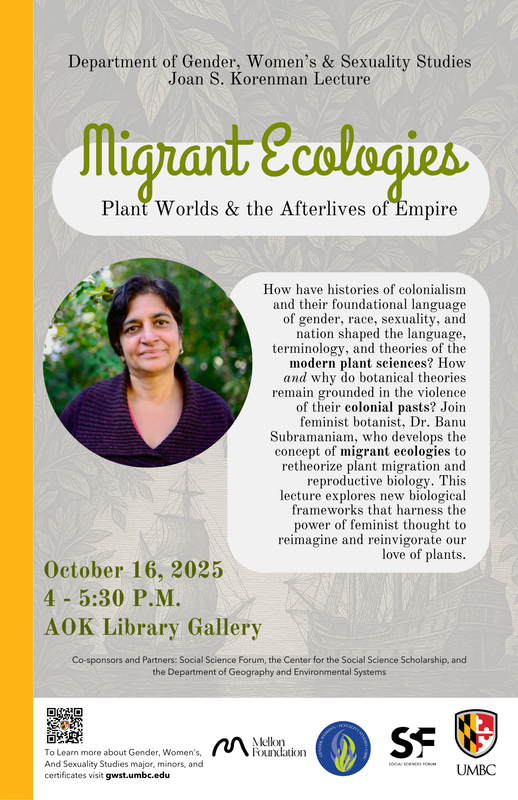
REPOST: Dr. Banu Subramaniam: Migrant Ecologies: Plant Worlds and the Afterlives of Empire
Korenman Lecture
Location
Library and Gallery, Albin O. Kuhn
Date & Time
October 16, 2025, 4:00 pm – 5:30 pm
Description
How have histories of colonialism and their foundational language of gender, race, sexuality, and nation shaped the language, terminology, and theories of the modern plant sciences? How and why do botanical theories remain grounded in the violence of their colonial pasts? Join feminist botanist, Dr. Banu Subramaniam, who develops the concept of migrant ecologies to retheorize plant migration and reproductive biology. This lecture explores new biological frameworks that harness the power of feminist thought to reimagine and reinvigorate our love of plants.
About the Speaker:
Dr. Banu Subramaniam is the Luella LaMer Professor of Women’s and Gender Studies at Wellesley College. Trained as a plant evolutionary biologist, Dr. Banu engages the feminist studies of science in the practices of experimental biology and is author of Botany of Empire (2024), Holy Science (2019) and Ghost Stories for Darwin (2016).
Co-sponsors and Partners: Social Science Forum, The Center for the Social Sciences Scholarship, and the Department of Geography and Environmental Systems
This event is open for full participation by all individuals regardless of race, color, religion, sex, national origin, or any other protected category under applicable federal law, state law, and the University's nondiscrimination policy.
Evolution of Reforestation as a Climate Solution
Exploring reforestation as a global climate solution
Location
Fine Arts : 011
Evolution of Reforestation as a Climate Solution – Online Event
Date & Time
October 15, 2025, 12:00 pm – 1:00 pm
Description
Join us in Fine Arts 011 at UMBC for this GES Seminar Series event!
Dr. Susan Cook-Patton
Lead Reforestation Scientist, The Nature Conservancy
Doing Community-Engaged Research: A Q&A with GES Faculty
Geography and Environmental Systems Seminar Series
Location
Fine Arts : 011
Doing Community-Engaged Research: A Q&A with GES Faculty – Online Event
Date & Time
October 8, 2025, 12:00 pm – 1:00 pm
Description
Panelists
- Matt Baker
- Dawn Biehler
- Mia Dawson
- Ellen Kohl
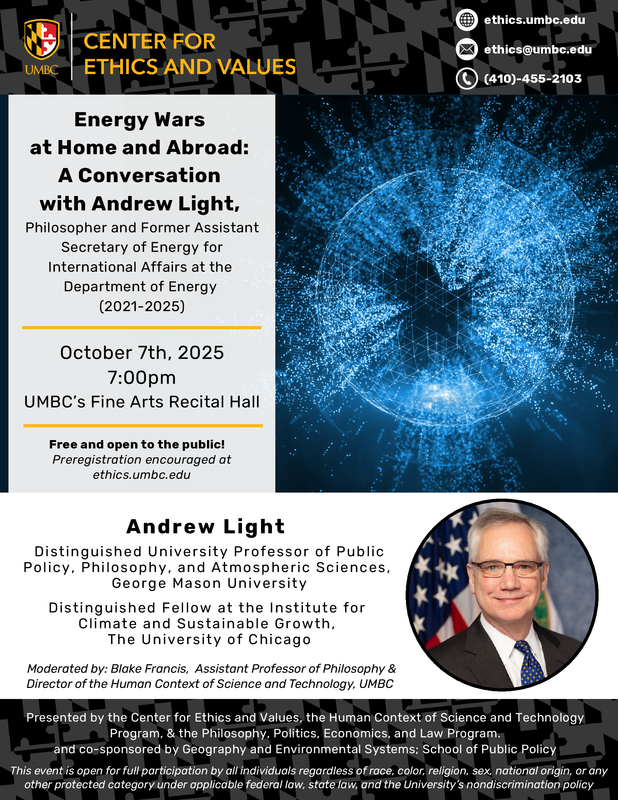
REPOST: Energy Wars at Home and Abroad : A Conversation with Andrew Light
Free and open to the public!
Location
Fine Arts : Recital Hall
Date & Time
October 7, 2025, 7:00 pm – 8:30 pm
Description
Energy Wars at Home and Abroad : A Conversation with Andrew Light
Pollution to Solution: The Power of Collaborative Environmental Research in Nigeria
Global partnerships tackling Nigeria’s pollution crisis
Location
Fine Arts : 011
Pollution to Solution: The Power of Collaborative Environmental Research in Nigeria – Online Event
Date & Time
September 24, 2025, 12:00 pm – 1:00 pm
Description
Join us for a presentation exploring how strategic international partnerships are transforming pollution challenges into scalable environmental solutions.
Speaker: Ngozi Oguquah
Nigerian Institute for Oceanography and Marine Research, Lagos, Nigeria
Pollution to Solution: The Power of Collaborative Environmental Research in Nigeria
Abstract: Nigeria faces severe environmental challenges, with 94% of its population exposed to air pollution exceeding WHO guidelines and ranking 9th globally in ocean plastic emissions. This presentation demonstrates how strategic international partnerships are transforming these challenges into innovative solutions with global scaling potential.
The collaborative framework involves the Royal Academy of Engineering, UK universities, the Nigerian Institute for Oceanography and Marine Research (NIOMR), and Nigerian policy institutions addressing pollution in Lagos State. Through integrated field investigations, laboratory analysis, and stakeholder engagement, the partnership achieved breakthrough discoveries, including the identification of contamination hotspots, comprehensive baseline data collection, and advanced chemical analysis that revealed concerning heavy metal levels in waterways.
Key innovations include machine learning for plastic identification in drone imagery, documentary creation for evidence-based advocacy, and capacity-building programs enhancing Nigerian scientists' capabilities through hands-on training and co-creation research methodologies. The research directly informed policy reforms on industrial waste disposal, reached over 50,000 residents through education campaigns, and established community-based plastic collection points.
The presentation concludes with replication pathways demonstrating that 85% of sub-Saharan African environmental challenges are addressable with Nigerian-developed solutions, offering 62% cost reductions compared to imported technologies across a potential 3.2 billion-person market. This represents a transformative model for global environmental collaboration.
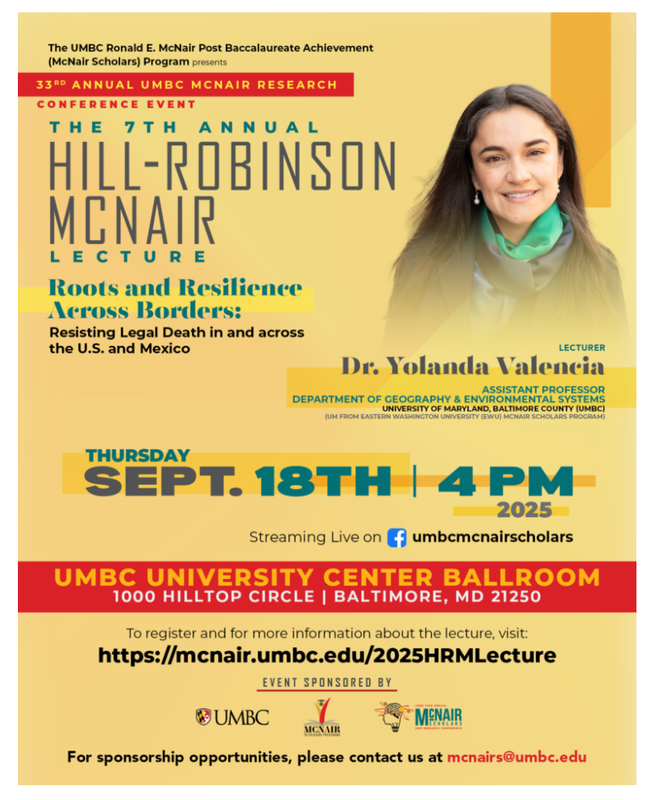
Hill-Robinson McNair Lecture & McNair Keynote
Roots and Resilience Across Borders
Location
University Center : Ballroom
Date & Time
September 18, 2025, 4:00 pm – 6:00 pm
Description
Join us for the 7th Annual Hill-Robinson McNair Lecture and 33rd Annual UMBC McNair Research Conference Keynote Event featuring Dr. Yolanda Valencia, Assistant Professor in the Department of Geography & Environmental Systems.
Lecture Title: Roots and Resilience Across Borders: Resisting Legal Death in and across the U.S. and Mexico
Date & Time: Thursday, September 18, 2025 at 4:00 PM
Location: UMBC University Center Ballroom & Streaming Live on Facebook at UMBC McNair Scholars
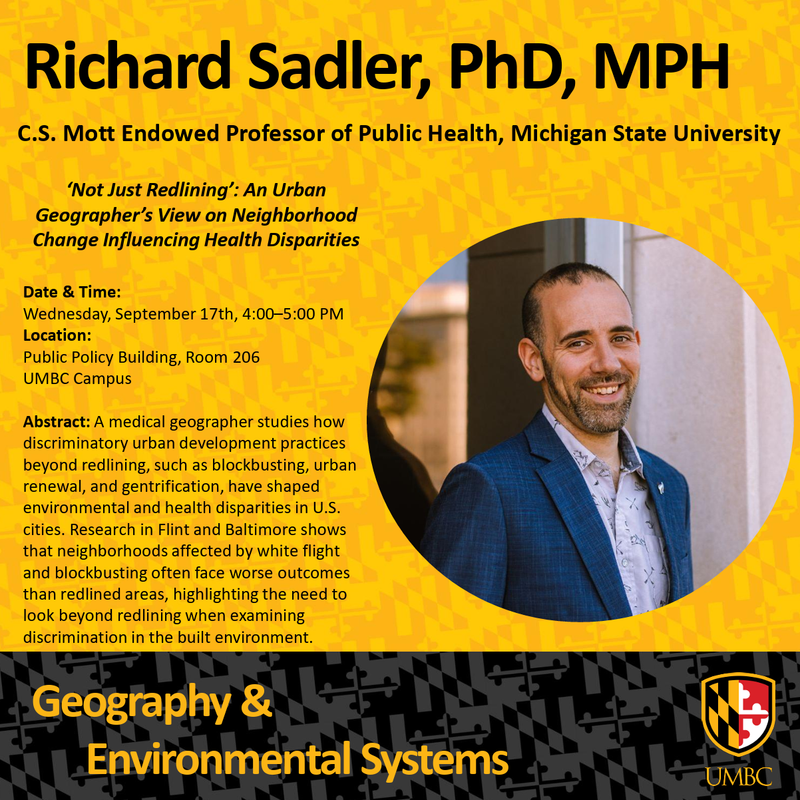
'Not Just Redlining': An Urban Geographer's View on Neighborhood Change Influencing Health Disparities
GES Seminar ft. Dr. Richard Sadler-Michigan State University
Location
Public Policy : 206
Date & Time
September 17, 2025, 4:00 pm – 5:00 pm
Description
Location
Sondheim Hall : Outside by Pool
Date & Time
September 12, 2025, 12:00 pm – 1:00 pm
Description
GES Graduation Reception
Celebrate GES' graduates
Location
Sondheim Hall
Date & Time
May 22, 2025, 12:00 pm – 1:00 pm
Description
Dr. Jared Margulies: What we can learn about conservation justice from the illegal plant trade?
GES alum (PhD '17) talks about illegal plant trade
Location
Library and Gallery, Albin O. Kuhn : Library Gallery
Date & Time
February 27, 2025, 4:30 pm – 6:00 pm
Description
Global Illegal wildlife trade presents a critical conservation and social development challenge. Inspired by other law-enforcement first responses to vexing conservation problems, many countries, conservation organizations, and conservation advocates continue to seek harsher sentencing laws and punishments for people found guilty of wildlife trafficking or poaching. Drawing on my research from over the past eight years on illegal wildlife trade in ornamental plants in a variety of international contexts, I will argue against this turn towards criminalization for perpetuating forms of conservation violence which ultimately undermines conservation goals. Instead, drawing from examples of ongoing collaborative research, I will make an argument for socioecological harm reduction in the illegal wildlife trade. Through examples from past research into the global illegal cactus and succulent trade, alongside ongoing research in the illegal trade in endangered succulents in South Africa and the carnivorous Venus flytrap in North Carolina, USA, I will suggest how criminalization in conservation reproduces social harms that may further perpetuate ecological harms. A socioecological harm reduction approach to the illegal wildlife trade draws our attention to the entwined struggles for social and ecological liberation.
- Go to page 11
- …
- Go to page 5
- Go to page 4
- Go to page 3
- Go to page 2
- Go to page 1