Special Presentation: NOAA CORS Network with John Galetzka
How GPS precision works behind everyday navigation
Location
Sondheim Hall : 001
Special Presentation: NOAA CORS Network with John Galetzka – Online Event
Date & Time
May 27, 2026, 12:00 pm – 1:00 pm
Description
The Department of Geography and Environmental Systems at UMBC invites you to a special presentation by John Galetzka of NOAA’s Continuously Operating Reference System (CORS) Network.
UMBC is part of the CORPS Network. A GPS/GNSS base station operated by the University from the roof of the AOK Library is one of hundreds of independently operating base stations across the US that contribute continuous positional data to the CORPS Network. These base stations improve the precision of data gathered by GPS satellites, allowing us to pinpoint our locations. We leverage this information every time we navigate on our phones.
Mr. Galetzka's work involves planning, installing, and maintaining base stations across the world (in some pretty interesting places). He will be on campus to tour UMBC's facility. He generously offered to present on the CORS Network and the role of our base station plays in it to the UMBC community.
Please join us for this engaging presentation and discussion on the technology behind modern navigation and geospatial precision.

Felipe Saad PhD Dissertation Defense | The Purple Giants within Tropical Forests: A Complex Legacy of Deforestation and Fires
Tracking the fate of tropical forest giants
Location
Sondheim Hall : 001
Date & Time
May 22, 2026, 1:00 pm – 2:00 pm
Description
The Purple Giants within Tropical Forests: A Complex Legacy of Deforestation and Fires, by Felipe Saad
The Department of Geography and Environmental Systems at UMBC invites you to attend the PhD Dissertation Defense of Felipe Saad
Abstract: Emergent trees play a disproportionate role in tropical forest function, yet their low density, long lifespans, and uneven distributions have limited understanding of their responses to disturbance. This dissertation develops an open-access, multi-sensor remote-sensing framework to detect individual crowns of Dipteryx panamensis and estimate persistence and mortality risk across northern Costa Rica and southern Nicaragua. First, I compared four optical and radar sensor configurations and found that models combining phenological and SAR structural information most accurately mapped D. panamensis across forest and non-forest environments (F1 = 0.94). Second, Bayesian hierarchical state-space models applied to 77,270 trees over nine years showed high baseline persistence (98.2%) but higher mortality risk under pasture isolation, fire exposure, and cumulative forest clearing, with weaker and more localized edge effects. Finally, a propensity-score-matched evaluation of protected areas showed that demographic protection did not always align with legal protection: annual mortality risk was lower in Costa Rica than Nicaragua overall, but increased inside protected areas in both countries, especially for disturbed trees in Nicaragua. Together, these results show that open-access remote sensing can move beyond forest-cover mapping to monitor individual tropical trees and evaluate conservation outcomes using demographic indicators.


Year End Celebration
Celebrating the Close of the Academic Year
Location
Sondheim Hall
Date & Time
May 21, 2026, 12:30 pm – 2:00 pm
Description
Join us in celebrating the end of the academic year immediately following Commencement. The Year-End Celebration will take place outside the basement level of Sondheim Hall near the pool. In the event of inclement weather, the celebration will be moved indoors to the basement level of Sondheim Hall.
We look forward to coming together as a community to close out the academic year!
GES Seminar: Graduate Student Talks
Final GES seminar featuring grad student research
Location
Sondheim Hall : 001
GES Seminar: Graduate Student Talks – Online Event
Date & Time
April 29, 2026, 12:00 pm – 1:00 pm
Description
Join us for the final GES seminar of the academic year featuring five graduate student presentations:
• Anisha Jayadevan: Planting trees in open natural ecosystems leads to limited carbon gains
• Hasan Ahmed: Tropical forest structural responses to fragmentation vary regionally and along biophysical gradients
• Megan Curtiss: Differential Tree Growth Responses Across Urban Site Types
• Leo Pecora: Looking Ahead: Digital Extraction of Geomorphic Metrics for Stream Assessment
• Felipe Saad: Persistence of Tropical Giants Across Disturbed Landscapes

GES Spring Seminar: Dr. Sarah Paige
Medical geography and global disease policy
Location
Sondheim Hall : 001
GES Spring Seminar: Dr. Sarah Paige – Online Event
Date & Time
April 1, 2026, 12:00 pm – 1:00 pm
Description
Please join the Department of Geography and Environmental Systems for our Spring Seminar Series.
Dr. Sarah Paige (University of Heidelberg) will present:
"How a Medical Geography Research Program Informed a Global Policy to Prevent, Detect, and Respond to Novel Zoonotic Disease Outbreaks."
This talk highlights how geographically informed research, particularly from the Kibale EcoHealth Project (KEP) in western Uganda which helped shape global health security frameworks. KEP supported interdisciplinary research from 2005–2017 on bat behavior, microbiomes, and zoonotic spillover risk in a region with high levels of human–animal contact. The project's findings contributed to the formation of a One Health Committee and influenced global policy approaches to emerging infectious diseases.
All GES Spring Seminars are held on Wednesdays from 12–1 PM in Sondheim Hall, Room 001.
Faculty, students, and guests are welcome.

REPOST: GES Spring Seminar: Dr. Sarah Paige
Medical geography and global disease policy
Location
Sondheim Hall : 001
REPOST: GES Spring Seminar: Dr. Sarah Paige – Online Event
Date & Time
April 1, 2026, 12:00 pm – 1:00 pm
Description
Please join the Department of Geography and Environmental Systems for our Spring Seminar Series.
Dr. Sarah Paige (University of Heidelberg) will present:
"How a Medical Geography Research Program Informed a Global Policy to Prevent, Detect, and Respond to Novel Zoonotic Disease Outbreaks."
This talk highlights how geographically informed research, particularly from the Kibale EcoHealth Project (KEP) in western Uganda which helped shape global health security frameworks. KEP supported interdisciplinary research from 2005–2017 on bat behavior, microbiomes, and zoonotic spillover risk in a region with high levels of human–animal contact. The project's findings contributed to the formation of a One Health Committee and influenced global policy approaches to emerging infectious diseases.
All GES Spring Seminars are held on Wednesdays from 12–1 PM in Sondheim Hall, Room 001.
Faculty, students, and guests are welcome.
GES Seminar: How Cool Are Your Trees? Heat and Vegetation in Cities
Urban heat, tree canopy, and human scale cooling in cities.
Location
Sondheim Hall : 001 (Cartography Lab)
Date & Time
March 5, 2026, 12:00 pm – 1:00 pm
Description
How Cool Are Your Trees? Heat and Vegetation in Cities
Every year people die because of extreme heat. Trees help combat the lethality of an increasingly warm planet, where cities are even warmer. Vegetation provides shade and evapotranspirative cooling, which lower temperatures and may save lives.
This talk draws from a review of more than 115 research papers from across the globe on urban vegetation and heat from 2018 to 2024. The When, Where, and How of urban cooling will be discussed, with attention to current knowledge and knowledge gaps.
We will also zoom into New Haven, CT to examine how bike mounted temperature sensors better reflect lived experience and demonstrate local level cooling from tree canopy cover with and without cloud cover. Ongoing bike based heat research in Baltimore will also be shared.
The goal is to describe the state of the field and provide a specific place based example of how trees provide cooling at the human scale.
GES Spring Seminar: Dr. Dexter Locke
Heat, vegetation, and urban tree cover
Location
Sondheim Hall : 001
Date & Time
March 4, 2026, 12:00 pm – 1:00 pm
Description
Please join the Department of Geography and Environmental Systems for our Spring Seminar Series.
Dr. Dexter Locke (United States Forest Service) will present a talk titled:
"How Cool Are Your Trees? Heat and Vegetation in Cities."
This seminar examines the relationship between urban vegetation, tree canopy, and heat exposure, highlighting how green infrastructure can shape environmental and social outcomes in cities.
All GES Spring Seminars are held on Wednesdays from 12–1 PM in Sondheim Hall, Room 001.
Faculty, students, and guests are welcome.
GES Spring Seminar: Dr. Dawn Biehler
Animals, urbanization, and green space in 19th-century NYC
Location
Sondheim Hall : 001
GES Spring Seminar: Dr. Dawn Biehler – Online Event
Date & Time
February 11, 2026, 12:00 pm – 1:00 pm
Description
Please join the Department of Geography and Environmental Systems for our Spring Seminar Series.
Dr. Dawn Biehler (UMBC) will present a talk titled:
"Reordering the more-than-human city: Stories of animals, urbanization, and green space in nineteenth-century New York."
This talk explores historical relationships between animals, urban development, and green space, and how these interactions shaped the modern city.
All GES Spring Seminars are held on Wednesdays from 12–1 PM in Sondheim Hall, Room 001.
Faculty, students, and guests are welcome.
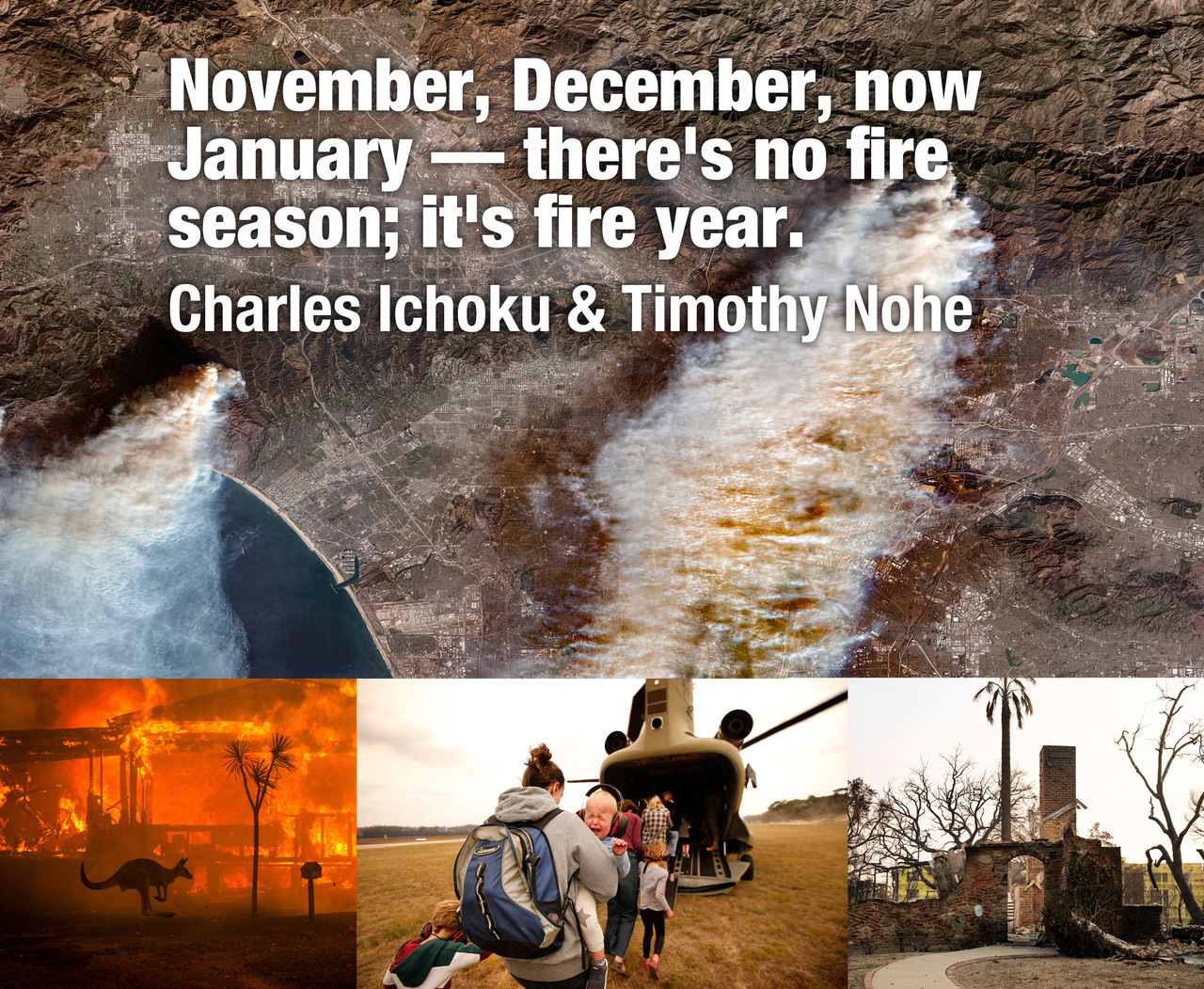
Art–Sci Fire Conversation: “There’s No Fire Season; It’s Fire Year”
A public art and climate science conversation on wildfires.
Location
Off Campus : The Peale
Date & Time
November 22, 2025, 3:00 pm – 4:00 pm
Description
As wildfires grow more frequent, more destructive, and more entwined with human settlements, the boundaries between natural disaster and human infrastructure are dissolving. In this public conversation and lecture, climate scientist Dr. Charles Ichoku and interdisciplinary artist Timothy Nohe explore the new era of fire year, where traditional "fire seasons" could collapse especially in regions that are becoming drier into a continuous, climate-fueled threat.
Dr. Ichoku, Director of the GESTAR-II Consortium and a leading researcher working with NASA on global wildfire emissions, brings a planetary perspective: monitoring and modeling fire dynamics from space and airborne platforms. His work captures fire's massive scales, how it affects the atmosphere, carbon cycles, and climate systems.
Nohe's telematic artwork "Fire Year" revisits the tragic Los Angeles fires of January 2026, a period marked by his daughter's evacuation from UCLA. As an artist, he is committed to communicating the alarming impact humans have on the environment.
- Go to page 11
- …
- Go to page 3
- Go to page 2
- Go to page 1