Events

Forest Fires in Western Cascadia

Drivers, characteristics & indicators of postfire resilience

Location

Online

Date & Time

November 17, 2021, 12:00 pm1:00 pm

Description

The Department of Geography & Environmental Systems cordially invites you to join us for our Virtual Seminar Series on Wednesday, November 17th at Noon ET.

Forest fires in western Cascadia: Drivers, characteristics, and indicators of post-fire resilience


Dr. Brian Harvey
Department of Environmental and Forest Sciences
University of Washington
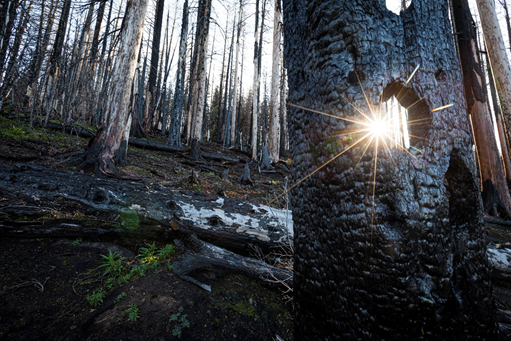
Understanding the mechanisms that underpin forest resilience to fires is of high importance as the climate warms and fire activity increases worldwide. This knowledge gap is particularly wide in forests characterized by infrequent and severe fires, since opportunities to study fire events are inherently rare. In a series of associated projects, we characterize factors associated with, and indicators of forest resilience to fire west of the Cascade Crest in Washington and northern Oregon, USA (‘western Cascadia’). Using satellite burn severity mapping and landscape ecological analyses, we characterize patterns and drivers of stand-replacing fire from 1984 to 2020, building an understanding of the spatial signature of the western Cascadia fire regime. In a network of intensively measured permanent field plots distributed across forests burned between 2015 and 2020, we measure how pre-fire forest structure, burn severity, and topoclimate relate to several key post-fire indicators of resilience. Specifically, data on post-fire tree regeneration, early-seral vegetation communities, woody carbon, and fuel profiles are critical early indicators of resilience and potential long-term post-fire trajectories. Collectively, findings provide valuable insights into the role that fire plays in shaping western Cascadia, and provide the foundation for understanding resilience to fire now and in the future.

Brian J. Harvey is the Jack Corkery and George Corkery Jr. Endowed Professor in Forest Sciences and Assistant Professor in the School of Environmental and Forest at the University of Washington. His research focuses on understanding the nature of forest disturbances (e.g., fires and insect outbreaks) – and how forest structure and function is shaped by disturbances, interactions among disturbances, and climate. His work spans field studies to large spatial datasets and analyses, drawing on insights from landscape ecology and community ecology. His research focus is on disturbance ecology of forests in coastal California, the US Rocky Mountains, and Pacific Northwest.


Tags:

Location

Online

Date & Time

November 4, 2021, 5:00 pm6:00 pm

Description

Join us for a (virtual) panel discussion full of tips on the process of applying to graduate school programs.  We'll spend some time talking about our own programs in GES, but the focus will be on general advice for identifying programs, finding mentors, and the overall application process

Faculty participating: 
Dr. David Lansing
Dr. Yolanda Valencia
Dr. Maggie Holland

Transit Equity & Environmental Health in Baltimore

Assessing investment in equitable transit infrastructure

Location

Online

Date & Time

November 3, 2021, 12:00 pm1:00 pm

Description

The Department of Geography & Environmental Systems cordially invites you to join us for our Virtual Seminar on Wednesday, November 3rd at Noon ET.

Transit Equity & Environmental Health in Baltimore


Dr. Megan Latshaw
Department of Environmental Health & Engineering
The Johns Hopkins University

Samuel Jordan
President, Baltimore Transit Equity Coalition

Public transit provides relatively low-cost access to jobs, food, healthcare and increased physical activity. Public transit also reduces pollution and greenhouse gas emissions by taking cars off the roads. Dr. Latshaw, along with Samuel Jordan of the Baltimore Transit Equity Coalition and several other experts did the first ever transit equity analysis for Baltimore City. Looking at transit, social vulnerability, air pollution & health effects, they identified 45 neighborhoods as opportunities for investment in transit infrastructure.

Megan Latshaw is the Director of Master’s Degree Programs in the Department of Environmental Health and Engineering at the Johns Hopkins University Bloomberg School of Public Health. She also serves as co-chair of University’s Sustainability Plan Steering Committee, and as core faculty for the Environmental Challenges Focus Area of the Bloomberg American Health Initiative. As faculty at Hopkins, her efforts focus on designing healthy communities, connecting environmental health research with the real world, and improving environmental health surveillance (all through a justice and equity lens).

Samuel Jordan founded the Baltimore Transit Equity Coalition (BTEC) in 2016 to complete the Baltimore Red Line light rail project and recover its transformative economic benefits for the Baltimore metropolitan region and the African American, Hispanic, low-income, and transit-dependent communities adversely affected by the cancellation of the project in 2015. He has conducted community livability, issue organizing, and skills training programs in Baltimore and Washington, DC over the last twelve years. As an advisor to the Washington, DC Department of Transportation, Mr. Jordan was honored by the National Capital Chapter of the American Planning Association in 2013 for his community livability tool, “Community Livability Outreach Advisors.” Mr. Jordan is a former Chair of the DC Statehood Party; former Executive Director of Health Care Now! Washington, DC; former Director of the Program to Abolish the Death Penalty at Amnesty International USA; former Director of Organizing for AFSCME District 20 and Representative of AFSCME Local 2093 in Washington, DC; former Executive Director of the National Education Association DC Office; and former Organizer of the US-Kurdish Solidarity Initiative.  Mr. Jordan holds a Juris Doctorate from the Georgetown University Law Center
Tags:

Location

Online

Date & Time

October 28, 2021, 7:00 pm8:30 pm

Description

Please join us on Thursday, October 28th at 7PM for the first part of The Baltimore Conversations, a panel series bringing together academics and community activists working in Baltimore. This panel will focus on the structures and strategies shaping housing and the everyday lives of Baltimoreans. We hope to challenge the dominant discourse of ‘progress’ that is predicated on systems of extraction by centering forgotten and marginalized narratives of the city. We invite dialogue on collectively shaping a right to the city.


Panelists include:

Mike Casiano, American Studies @ UMBC, Charm City Land Trust
Shelley Halstead, Black Women Build - Baltimore
Paige Glotzer, History @ University of Wisconsin
Eli Pousson, Neighborhood Design Center

Moderated by Dena Aufseeser (Geography and Environmental Systems, UMBC) and Dillon Mahmoudi (Geography and Environmental Systems, UMBC). Event generously sponsored by the Urban Geography journal with support from University of Maryland Baltimore County, Towson University, & Goucher College.

Location

Online

Date & Time

October 27, 2021, 5:00 pm6:00 pm

Description

To all new & continuing GES Majors/Minors (or those considering joining us) - We're hosting a faculty panel discussion to help orient you to how to plan out your degree, explain more about our degree pathways, and highlight upcoming courses.  As you consider what you'd like to do for the spring '22 semester and beyond, we'll be there to answer some questions (in advance of your advising sessions).  
Join us (online) on Wednesday, October 27th at 5pm.  
Featuring: Dr. Maggie Holland, Dr. Dawn Biehler, and Dr. Dillon Mahmoudi.

Integrating Hydrologic and Ecological Models

Economic analysis of water resource policy

Location

Online

Date & Time

October 20, 2021, 12:00 pm1:00 pm

Description

The Department of Geography & Environmental Systems cordially invites you to join us for our Virtual Seminar on Wednesday, October 20th at Noon ET.

Integrating hydrologic and ecological models into economic analysis of water resource policy


Dr. Yusuke Kuwayama
School of Public Policy
University of Maryland, Baltimore County

Dr. Yusuke Kuwayama is an Assistant Professor in the School of Public Policy at the University of Maryland, Baltimore County, and a Fellow at Resources for the Future (RFF) in Washington, DC. He is a Principal Investigator on a project supported by the National Socio-Environmental Synthesis Center (SESYNC) titled Advancing Integrated Process-Based Modeling of Complex Socio-Environmental Systems. He also currently serves as Director of the Consortium for the Valuation of Applications Benefits Linked with Earth Science (VALUABLES).

Dr. Kuwayama’s research focuses on the economics of water resource management. He strives to conduct economic analysis that leads to effective and efficient policy solutions for three major problems related to water quality and scarcity:
  • Inefficient water use in the agricultural sector;
  • Tradeoffs across economic and ecosystem uses of water; and
  • Wastewater management.
The methods and techniques Dr. Kuwayama uses to address these issues depend on the specific research question, but usually consist of applied microeconomic theory, dynamic optimization, applied econometrics, and policy analysis. Dr. Kuwayama is particularly interested in interdisciplinary approaches to address questions involving sustainable use and management of coupled human-natural systems, especially work that requires modeling human decision-making, hydrologic and ecological processes, and the connections between them.

Dr. Kuwayama completed his bachelor’s degree in Economics at Amherst College and his MS and PhD in Economics and Agricultural and Applied Economics at University of Illinois-Urbana Champaign.
Tags:

A Summer Of Flash Flood Disasters In 2021

GES Department Seminar featuring Dr. Jeffrey Halverson

Location

Online

Date & Time

October 13, 2021, 12:00 pm1:00 pm

Description

The Department of Geography & Environmental Systems cordially invites you to join us for our Virtual Seminar on Wednesday, October 13th at Noon ET.

A Summer Of Flash Flood Disasters In 2021: The new normal in this era of climate change?


Dr. Jeffrey Halverson
Department of Geography and Environmental Systems
University of Maryland, Baltimore County

Major flash flood events in the U.S. in recent months (Tennessee, New York City), in Germany, and now Italy as well, have led to significant loss of life and property.  This talk briefly looks at the causes of these events, examining them through a multifactorial lens with focus on how global warming may be contributing to the frequency and magnitude of these disasters.

Dr. Jeff Halverson is currently Professor of Geography and Environmental Systems and Associate Dean in The Graduate School.  As an expert on severe storms, in 2001 he helped pioneer a new aircraft-based, upper atmospheric measuring system to take direct observations in the eye of hurricanes for NASA.  He and his team of grad students conduct research on thunderstorm electrification, Nor'easters and severe weather warnings.  Halverson teaches GES courses on Weather and Climate, Climate Change, Severe Storms, and Natural Hazards.  He is presently working with scientists at NOAA’s Ocean Prediction Center to study extratropical and tropical transition of ocean cyclones, and is a regular writer for the Washington Post's Capital Weather Gang.  He worked with researchers in GES and CUERE to understand the generation and impacts of the Ellicott City flash floods in 2016 and 2018.
Tags:

How Urbanization Of Grasslands In The Denver Region Changes

CUERE Fall Seminar featuring Dr. Aditi Bhaskar

Location

Online

Date & Time

October 8, 2021, 2:00 pm3:00 pm

Description

On behalf of the Center for Urban Environmental Research and Education and their Fall 21 Seminar Series, the Department of Geography & Environmental Systems cordially invites you to join us for a Virtual Seminar on Friday, October 8th at 2PM ET.

How urbanization of grasslands in the Denver region changes streamflow


Dr. Aditi Bhaskar
Department of Civil and Environmental Engineering
Colorado State University

This talk presents an analysis of the changes to streamflow in the semi-arid area of Denver, Colorado, USA with a focus on (1) contributors to stream baseflow and (2) an analysis of changes in streamflow response to rainfall events with urbanization.  To estimate contributions to stream baseflow, we used water-stable isotope (δ18O and δ2H) analysis of surface water, tap water, and precipitation. Thirteen urban streams and two grassland streams were selected for sampling. An isotope mixing analysis using tap and precipitation end-members over a two week antecedent period estimated that tap water contributed a mean of 80% of urban baseflow on specific days in late summer. After taking contributions from infrastructure leakage into account, we estimated that lawn irrigation return flows made up 32% to 82% of analyzed baseflow. For changes to streamflow response to rainfall events, we used eight years of instantaneous streamflow data in 21 watersheds ranging in size from 1 to 90 km2 with impervious areas ranging from 1% to 47%.  Using a semi-automated method to identify a total of 2,877 streamflow events, we analyzed event-based metrics of peak flow, runoff depth, runoff ratio, time to peak, duration, and number of streamflow events occurring in response to rainfall events, in addition to precipitation threshold and zero flow.  We found that more impervious watersheds had perennial or nearly perennial flow, unlike the least impervious watersheds which usually were dry.  Streamflow events were shorter in duration and had higher peak flow in watersheds with more impervious surface cover.  This work points to the need for local adaptation of stormwater management that seeks to mitigate the effects of streamflow changes with urbanization.

Dr. Bhaskar specializes in changes to hydrologic systems from urban development, with a focus on interactions between groundwater, surface water, and engineered stormwater and water distribution systems. Dr. Bhaskar received a Sc.B. in Geology-Physics/Math from Brown University in Providence, Rhode Island, and a Ph.D. in Environmental Engineering from University of Maryland, Baltimore County. She was a graduate trainee of the National Science Foundation Integrative Graduate Education and Research Traineeship (IGERT) in “Water in the Urban Environment” at UMBC. Dr. Bhaskar was then awarded a National Science Foundation Earth Sciences Postdoctoral Fellowship, which took her to the Eastern Geographic Science Center at the U.S. Geological Survey in Reston, Virginia, before joining CSU.

The Forests We Need, the Forests We Create

GES Department Seminar featuring Dr. Matthew Fagan

Location

Online

Date & Time

October 6, 2021, 12:00 pm1:00 pm

Description

The Department of Geography & Environmental Systems cordially invites you to join us for our Virtual Seminar Wednesday, October 6th at Noon ET.

The Forests We Need, The Forests We Create: Restoring a degraded planet with ugly maps and space lasers


Dr. Matthew Fagan
Department of Geography and Environmental Systems
University of Maryland, Baltimore County

Matt received his undergraduate degree in Ecology, Evolution, and Conservation Biology from the University of Texas at Austin. He then went on to get a Master’s degree at Dartmouth College, where he studied the impact of the invasive shrub glossy buckthorn (Frangula alnus) on tree seedling recruitment. After Dartmouth, Matt spent several years working for the Nature Conservancy and as a high school biology teacher, before starting a Ph.D. in the E3B department at Columbia University with Ruth DeFries.  His thesis work focused on land cover change and functional connectivity in the San Juan-La Selva Biological Corridor in northern Costa Rica. Matt then did a postdoc with Doug Morton at the NASA Goddard Biospheric Sciences Lab before starting as an assistant professor in the Department of Geography and Environmental Systems at the University of Maryland, Baltimore County (UMBC).  His lab’s research at UMBC lies at the intersection of remote sensing, conservation policy, and ecology, with specific focal areas in monitoring agricultural expansion and forest recovery, assessing the effectiveness of conservation and restoration policies, and using remote sensing to assess landscape-scale habitat degradation.  Their work takes them to central America, India, the Bahamas, and the wilds of suburban Maryland
Tags:

Farce Followed by Failure: The US Saving Afghan Women Trope

GES Department Seminar featuring Dr. Jennifer Fluri

Location

Online

Date & Time

September 29, 2021, 12:00 pm1:00 pm

Description

Jennifer L. Fluri is Professor and Chair of the Department of Geography at the University of Colorado-Boulder. She is a political geographer interested in gender, geopolitics, international assistance, economic development, and conflict in Afghanistan. She has published over thirty peer reviewed journal articles and book chapters. Her publications also include three co-authored books and one co-edited book. She is the co-author of The Carpetbaggers of Kabul and other American-Afghan Entanglements, published in 2017 by University of Georgia Press as part of the Geographies of Social Justice series.  Her current research project examines gender, security, and development in Afghanistan with a focus on Afghan women’s leadership, which if funded by the National Science Foundation. She is the co-editor of the Gender, Feminisms and Geography book series at West Virginia University Press, and she serves of the editorial board for the journal of Political Geography and the journal of Cultural Geography. She received a Fulbright Fellowship in 2020 to examine the experiences of young Afghans seeking hired education in India and will begin this project in 2022. In Colorado, she co-directs the Boulder Affordable Housing Research Initiative, a community-based service-research project that provides information for individuals and organizations seeking, living in, or caring about affordable housing. More details about her research and teaching can be found at jenfluri.com.


Tags: