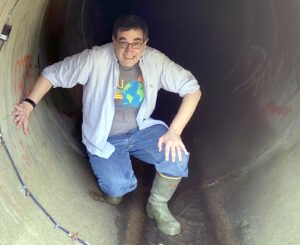
Ph.D., Johns Hopkins University, 1983
Emeritus Professor
211-I Sondheim Hall
443-904-4484
miller@umbc.edu
Note to prospective graduate applicants: As I am retiring on January 1, 2025, I am no longer able to accept new graduate students.
Research Interests
I am interested in the hydrology, hydraulics and geomorphology of extreme floods with a particular focus on urban floods and more recently on the potential impact of climate trends on rainfall intensity and flood frequency. Additional research interests include fate and transport of sediment in the landscape, including sediment released by dam removal as well as historical legacy sediment stored in valley bottoms; the effectiveness of stream restoration and other approaches to mitigation of the consequences of urban development and urban runoff; and the application of Structure from Motion, 2-d hydraulic modeling, and Particle Image Velocimetry to simulate or reconstruct flood flows. I am interested more generally in watershed-scale response to environmental stress and to restoration efforts.
Selected Publications
Easton, J., Stephenson, K., Benham, B., Böhlke, J.A., Buda, A., Collick, A., Fowler, L., Gilinsky, E., Miller, A., Noe. G., Palm-Forster, L.H., Shabman, L., Wynn-Thompson, T., submitted. The Nonpoint Source Challenge: Obstacles and Opportunities for Meeting Nutrient Reduction Goals in the Chesapeake Bay Watershed. Journal of the American Water Resources Association.
Smith, J.A., S. Vimal, M.L. Baeck, and A.J. Miller, 2024. Cloudbursts and the upper tail of short-duration rainfall: Hortonian perspectives. Hydrological Sciences Journal.
Khan, S.T., T.M. Wynn-Thompson, D.J. Sample, M. Al-Smadi, A.J. Miller, 2024. Effectiveness of Stormwater Control Measures in Protecting Stream Channel Stability. Hydrological Processes
Metes, M.J., A.J. Miller, M.E. Baker, K.G. Hopkins, D.K. Jones, 2024. Remotely mapping gullying and incision in Maryland Piedmont headwater streams using repeat airborne lidar. Geomorphology 455
Smith, J.A., Baeck, M.L., Miller, A.J., and Claggett, E., 2024. Rainfall frequency analysis based on long-term high-resolution radar rainfall fields: spatial heterogeneities and temporal nonstationarities. Water Resources Research, 60, e2023WR035640.
Collins, M.J., Baker, M.E., Cashman, M.J., Miller, A.J., Van Ryswick, S., 2024. Impounded sediment and dam removal: erosion rates and proximal downstream fate. Earth Surface Processes and Landforms
Chesapeake Bay Scientific and Technical Advisory Committee (STAC), 2023. Achieving water quality goals in the Chesapeake Bay: An evaluation of system response (K. Stephenson and D. Wardrop, Eds.) Report Steering Committee: Benham, B., Buda, A., Dennison, W., Easton Z., Gilinsky, E., Miller, A.J., Monaco, M, Rose, K., Shabman, L., Stephenson, K., Testa, J. 115 pp.
Metes, M. J., Jones, D. K., Baker, M. E., Miller, A. J., Hogan, D. M., Loperfido, J. V., Hopkins, K. G., 2022. Ephemeral Stream Network Extraction from Lidar-Derived Elevation and Topographic Attributes in Urban and Forested Landscapes. Journal of the American Water Resources Association (Paper JAWR-20-0163-P).
Miller, A.J., C. Welty, J.M. Duncan, M.L. Baeck, and J.A. Smith, 2021. Assessing urban rainfall-runoff response to stormwater management extent. Hydrological Processes
Bhaskar, A.S., K. G. Hopkins, B. K. Smith, T. A. Stephens, A. J. Miller , 2020. Hydrologic signals and surprises in U.S. streamflow records during urbanization. Water Resources Research,
Gellis, A., C. Fuller, P. van Metre, B. Mahler, C. Welty, A.Miller, L. Nibert, Z. Clifton, J. Malen, J.T. Kemper, 2020. Pavement alters delivery of sediment and fallout radionuclides to urban streams. Journal of Hydrology.
Kemper, J.T., A.J. Miller, and C. Welty, 2019. Spatial and temporal patterns of suspended sediment transport in nested urban watersheds. Geomorphology 336: 95-106.
Miller, A., M. Baker, K. Boomer, D. Merritts, K. Prestegaard, and S. Smith, 2019. Legacy Sediment, Riparian Corridors, and Total Maximum Daily Loads. STAC Publication Number 19-001, Edgewater, MD. 64 pp.
Barnes, M. L., Welty, C., & Miller, A. J., 2018. Impacts of development pattern on urban groundwater flow regime. Water Resources Research, 54.
Miller, A.J., M.E. Baker, M. Collins, and D. Merritts, 2018. Field observations of the lower Patapsco River in the aftermath of the Bloede Dam removal. American Geophysical Union Centennial Meeting, Earth & Planetary Surface Processes Section. 33 p.
Collins, M.J., N.P. Snyder, G. Boardman, W.S.L. Banks, M. Andrews, M. Conlon, A. Gellis, S. McClain, A.J. Miller, P. Wilcock, 2017. Channel response to sediment release: insights from a paired analysis of dam removal. Earth Surface Processes and Landforms.
Donovan, M., A. Miller, M. Baker, 2016. Reassessing the role of milldams in Piedmont floodplain formation and remobilization. Geomorphology 268: 133-145.
Cole, J.N., A.J. Miller, E. Stapleton, and C. Welty, 2016. Quantifying spatial patterns of channel geometry and stream incision in an urban drainage network. Journal of Hydrologic Engineering
Current Graduate Students
Gina Lee (PhD student)
Erin Hamner (MS student, co-advised with Matthew Baker)
Tyrah Cobb-Davis (MS student, co-advised with Matthew Baker)
Philip Worster (MS student, co-advised with Matthew Baker)
Other Graduate Committees
Nicholas Simeone, MS student, GES, UMBC
Maryam Rishehri, PhD student, Chemical, Biological and Environmental Engineering, UMBC
Max Huffman, PhD student, Geological Sciences, University of Delaware
Maliha Mushtari, PhD student, Biological Resources Engineering, Virginia Tech
Courses Taught
Physical Geography, Principles of Geology, Geomorphology, Water Quality, Natural Environment of Chesapeake Bay, Water Resources, Hydrology, Fluvial Geomorphology, Introduction to Geography and Environmental Systems, Water in the Urban Environment, Research Design for the Urban Environment, Dams and Their Impacts
Research Support (2018-present)
U.S. Department of Energy, Baltimore Social-Environmental Collaborative. (September 1, 2022 – August 31, 2027). Project Director: B. Zaitchik, Johns Hopkins University, UMBC PI: C. Welty, UMBC co-PI: A. Miller. My main role has been to provide access to high-resolution bias-corrected radar rainfall fields developed at Princeton University by M.L. Baeck and J.A. Smith and to consult on urban flood questions.
Chesapeake Bay Trust, Evaluation of watershed-scale impacts of stormwater management facilities on thermal loads to a Maryland Class IV stream using a high-frequency sensor network. (June 30, 2021 – Nov. 15, 2024). PI: C. Welty, co-PI, A. Miller
National Science Foundation 19-586 Critical-Zone Collaborative Network. (September 1, 2020 – August 31, 2025). ‘Collaborative Research: Network Cluster: Urban Critical Zone processes along the Piedmont-Coastal Plain transition. PI and Project Director: C. Welty, co-PI(UMBC): A.J. Miller. My main role involves analysis and comparison of urban sediment patterns and processes across a set of Urban Critical Zone watersheds in the Piedmont of Pennsylvania, Maryland, and Virginia, working with K. Prestegaard at University of Maryland College Park and L. Toran at Temple University.
Chesapeake Bay Trust, (July 1, 2018 – December 31, 2020). ‘Effectiveness of Stormwater Management Practices in Protecting Stream Channel Stability.’ PI: T. Thompson, co-PIs: D. Sample, A.J. Miller.
Chesapeake Bay Trust, $288,267. (July 1, 2018 – June 30, 2020). ‘Assessment of the Effectiveness of Stream Restoration on Nitrate Loads in Nested Urban Watersheds.’ PI: C. Welty, co-PIs: A.J. Miller, J. Duncan.
Synergistic activities
2024: Session Convenor, “Human-Landscape Interactions in Urban and Rural Systems,” American Geophysical Union Fall Meeting, Washington, D.C., Dec. 11, 2024.
2023-present: Member, Maryland Commission on Environmental Justice and Sustainable Communities
2023-present: Member, Maryland Dept. of Environment Watershed Studies Technical Advisory Committee
2023: Member, Expert Panel Exploratory Workgroup for Conowingo Dredging, Maryland Dept. of Environment
2019-present: Editorial Board, Geomorphology
Member, (2013-2023), Vice-Chair (2017-2019), Chair (2019-2021), Immediate Past Chair (2021-2023), Chesapeake Bay Program Scientific and Technical Advisory Committee (STAC)
Chair of steering committee for STAC Workshop and Report on Legacy Sediment, Riparian Corridors, and Total Maximum Daily Loads (2017-2019)
Chair of sediment committee, Chesapeake Bay Program Modeling in 2025 and Beyond: a Proactive Visioning Workshop, Shepherdstown, MD. 2018.
Member and Secretary, Baltimore County Commission on Environmental Quality (2011-present)
Volunteer Leadership Activities
2025- : Board member, Irvine Nature Center
2021-present: Leadership Council, Jews United for Justice (Baltimore)
2019-present: Chair and Co-Chair, Synagogue Social Justice Roundtable (Baltimore, with JUFJ)
2016-present: Chair, Social Justice Advocacy Committee, Chizuk Amuno Congregation, Baltimore
2014-2016: President, Chizuk Amuno Congregation, Baltimore